How to improve your Google rating consistently
Improve your Google rating with better experience, ethical requests and a review management routine.
Ratings improve through process, not shortcuts
Improving your Google rating requires two fronts: reducing bad experiences and increasing real reviews from satisfied customers. Buying reviews or manipulating feedback is not a healthy strategy.
The rating is the result of customer experience plus a routine for requesting and answering reviews.
Understand what pulls the rating down
Read negative reviews and group causes. Delays, communication, service, price and misaligned expectations are common themes. If the root cause is not fixed, new negative reviews will keep appearing.
Reputation starts inside operations.
Generate recent reviews
Satisfied customers do not always review spontaneously. Send requests at the right time, with a direct link and a short message. Use NPS to identify promoters and avoid out-of-context requests.
The goal is real volume, not forced ratings.
Where Rankke.me fits in this strategy
A direct Google review link is useful, but sending it to every customer is not always the safest strategy. The link removes friction, but it also removes context. If an unhappy customer receives that link before the company understands the problem, the business may be guiding dissatisfaction straight into a public channel.
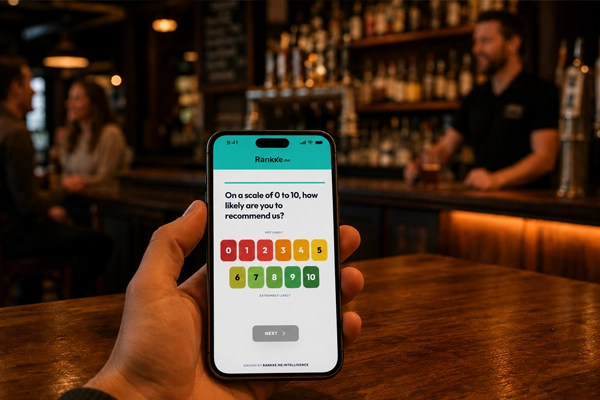
Rankke.me works one step before the Google review. The customer first enters a controlled reputation flow, answers a satisfaction question and reveals whether the experience was positive, neutral or negative. When the answer indicates satisfaction, the platform can guide that customer to Google with a clearer and more relevant request. When the answer indicates risk, the company can open a private recovery path instead of encouraging a public complaint.
This does not replace the Google Business Profile. It protects it. Google remains the visible trust point, while Rankke.me helps decide when and how to invite customers to contribute there. The result is a more consistent flow of positive reviews and less chance of turning unresolved frustration into visible damage.
For local businesses, this distinction is important. Reputation growth is not only asking more often. It is asking the right people, at the right moment, after listening first.
How to use the article in a conversion workflow
The practical conversion opportunity is to stop treating review requests as isolated messages. A business should know who receives the request, which experience triggered it, which channel delivered it and what happened afterward. Without this structure, the team may celebrate a few new reviews while missing unhappy customers who needed attention.
A safer workflow has three stages. First, listen privately with a satisfaction question. Second, separate customers by risk and enthusiasm. Third, guide satisfied customers to the public review page while routing dissatisfied customers to recovery. This protects the brand and creates a healthier review profile over time.
The result is more than a better rating. The company creates a visible proof system that supports sales, local search, paid media, referrals and the trust needed for a new customer to choose the business.
Reply and recover
Replying shows presence. Recovering unhappy customers can reduce damage and sometimes lead to updated comments.
Rankke.me helps create this flow of satisfaction, review requests and monitoring.
How to turn this topic into a routine
To apply How to improve your Google rating consistently without improvisation, define the moments when customers are most likely to be satisfied. This may happen after a completed delivery, a well-rated appointment, a resolved support case, a repeat purchase or a positive answer in a satisfaction survey.
From there, the review request should be simple, direct and contextual. The customer needs to understand why their opinion matters, receive an easy link and never feel pressured. The less friction there is, the easier it becomes to turn real satisfaction into a public review.
Metrics to monitor
Track new reviews per week, average rating, rating distribution, response speed and recurring themes. Also check whether recent reviews reflect the company's current experience. A profile with many old reviews may look strong, but an active profile creates stronger confidence.
Another important metric is invitation coverage. If many satisfied customers never receive a request, the business loses social proof every day.
A practical 30-day plan
In week one, review the Google review link and sending channels. In week two, choose the best request moments and write messages for each context. In week three, organize replies for praise and criticism. In week four, analyze received comments and turn patterns into internal actions.
This process creates a light routine: ask at the right moment, reply carefully and learn from what appears publicly.
Mistakes that reduce impact
Avoid buying reviews, offering rewards, asking only friends or telling customers which score to give. Besides damaging trust, these practices can create risk for the company profile.
Rankke.me helps prioritize satisfied customers, reduce request friction and keep reputation management ethical and measurable.
Practical example
Consider a local business that decides to send the Google review link by WhatsApp to every customer at the end of the day. At first, this looks efficient. The team saves time, the message is easy to send and some customers will leave positive comments. The hidden risk is that the same message also reaches people who are annoyed, unresolved or still waiting for a response.
A Rankke.me flow changes the order of the process. Instead of starting with the public link, the company starts with a quick satisfaction signal. Customers who had a positive experience move toward the Google review invitation. Customers who had a negative experience are directed to a private recovery path. The business still generates more reviews, but it does so with more control over risk.
This approach is especially useful for companies that depend on local trust. A single unresolved review can influence future buyers, while a steady flow of real positive reviews can make the business look safer, more active and easier to choose.
How to deepen the analysis before deciding
The next step is to look beyond review volume. A company can generate more Google reviews and still fail to convert if the comments are vague, if recent reviews mention the same problem or if the team does not reply with consistency. Quality, recency and context matter as much as quantity.
A strong analysis separates review sources and moments. Reviews requested after a successful appointment may behave differently from reviews requested after delivery, support or in-store service. When the business understands which moments create the best visible trust, it can ask with less pressure and better timing.
Negative or neutral signals should also be studied before they become public. A customer who is not ready to recommend the business may still be recoverable. That is why the Rankke.me flow is safer than simply distributing the Google link everywhere. It gives the team a private listening step before deciding whether the public review request makes sense.
The commercial goal is a profile that helps future buyers trust the company faster: recent reviews, specific comments, professional replies and a rating that reflects the current operation.
Frequently asked questions
Can I delete bad reviews?
Not always. Only reviews that violate policies may be removed.
How long does rating improvement take?
It depends on current volume and the number of new reviews.
Does asking for reviews help?
Yes, when done ethically and at the right time.
Should I reply to old reviews?
It can be useful, especially negative reviews without a response.