AI recommendations: how to prepare your local business to be found
See how clarity, reviews and reputation help clinics, restaurants, schools and local businesses be better understood by AI.
The name is technical, but the idea is simple
GEO, or generative engine optimization, is a new name for an old concern: your business must be easy to understand and easy to trust. Instead of thinking only about appearing in a list of links, the business also needs to be ready to appear in AI answers, comparisons and recommendations.
For the owner of a clinic, pizzeria, school or franchise, the practical question is: when someone asks for a recommendation, is there enough clear and trustworthy information about my business for it to be considered a good option?
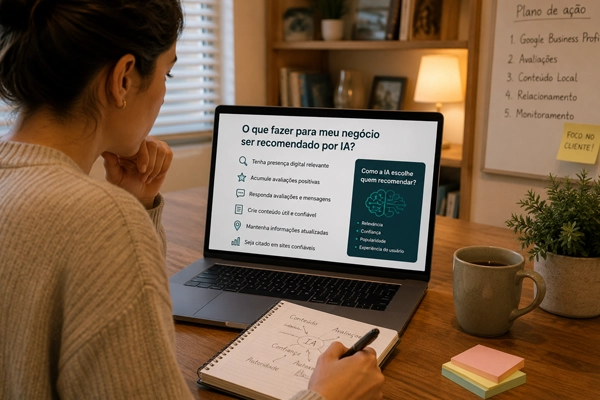
AI depends on what is visible
AI tools do not visit your business or experience your service directly. They depend on what is available: website pages, reviews, comments, service descriptions, photos, replies, social profiles and other public mentions.
If a clinic has clear information about specialties, location, booking and recent reviews, it is easier to understand what it offers. If a pizzeria has an updated menu, correct hours, good photos and recent comments about delivery and taste, it is easier to connect it with a local search.
Clarity beats complicated language
You do not need technical writing to look trustworthy. For local businesses, simpler language usually works better. Customers want to quickly understand whether you solve their problem.
A good page answers simple questions: where are you located? What do you offer? Who is it for? How does it work? What do other customers say? How can someone contact you? If these answers are hidden, scattered or unclear, the business loses strength.
Reputation is part of the answer
When someone compares businesses, reviews work as proof. A clinic may say it offers good care, but patient comments about attention, punctuality and clarity reinforce that promise. A pizzeria may say delivery is fast, but recent reviews confirming that are much more convincing.
Digital reputation is not a small marketing detail. It is a layer of trust that influences people, Google and AI tools.
Where Rankke.me fits
Rankke.me helps turn real experiences into reputation with more control. Instead of sending every customer directly to Google, the business first asks how the experience went.
Satisfied customers can receive the invitation to leave a public review. Unhappy customers can be handled privately, with a chance for recovery before a complaint becomes visible to everyone.
This flow is especially useful for local businesses. A clinic protects the patient relationship. A pizzeria quickly understands whether delivery or service failed. A franchise compares locations and identifies where the experience needs attention.
What to do in practice
Start by reviewing the main pages of the business. Read them like a customer who has never heard of the brand. In a few seconds, can they understand what the business does and why they should choose it?
Then look at reviews. Are they recent? Do they mention the things that actually sell your business? Does the business reply to praise and criticism? Are there repeated complaints that should become internal improvements?
Next, create simple content for common questions. A clinic can explain when to seek a specialty. A pizzeria can explain event options or delivery care. A school can answer parents' questions about adaptation and safety.
Finally, connect everything to a listening process. Every positive experience can become visible trust. Every negative experience can become learning and recovery.
What to avoid
Avoid turning this subject into a technical checklist that the operation does not understand. A business owner does not need to start with complicated terms. They need the company to be clear, trustworthy, updated and well reviewed.
Also avoid generic content. Articles that could fit any company are weak. The best content comes from real questions customers ask at the counter, on WhatsApp, at reception or before buying.
Examples by business type
In a clinic, content can answer questions that appear before booking: when to look for a specialty, which signs deserve attention, how the first appointment works and what the patient should expect. This kind of explanation reduces insecurity and shows that the clinic understands the patient journey.
In a pizzeria or restaurant, content can be even simpler: delivery areas, size differences, options for events, delivery care, busy hours and how to order for groups. It sounds basic, but it is exactly what customers want to know before choosing.
In a school, course or franchise, the questions change: safety, method, communication with families, consistency across locations, support and follow-up. When these answers are clear, the customer does not have to guess whether the business is organized.
How to turn this into a routine
Choose one real question per week and answer it simply. Use questions that already appear on WhatsApp, at the counter, at reception or in sales conversations. Then connect those answers to the proof that matters most: recent reviews, real photos, updated information and customer comments.
Rankke.me becomes the operational part of this routine. It helps the business listen to customers after the experience, separate satisfied customers from those who need attention and turn good service into public reviews. That way, the company does not depend only on content to look trustworthy; it starts showing real trust built with real customers.
A simple checklist to review today
Before thinking about any advanced tactic, answer this: can customers understand what you do in a few seconds? Are your reviews recent? Do you reply to criticism politely? Do satisfied customers receive a review invitation? Do unhappy customers have a private channel to be heard?
If the answer is no to any of these points, there is a concrete improvement opportunity. For local businesses, clarity and reputation usually bring more value than any sophisticated action done before the basics.
How to explain this to the team
This subject should become a simple team conversation: every customer experience can strengthen or weaken the company's reputation. The person at the counter, the WhatsApp attendant, the delivery team, the receptionist and the person handling complaints all participate in this process.
That is why it is not enough for the business owner to know reviews matter. The team needs to understand when to ask for feedback, how to thank compliments, how to route complaints and why unhappy customers should not be pushed directly to Google.
A simple routine helps: after a good experience, send the Rankke.me survey; if the answer is positive, invite the customer to review; if it is negative, handle it first. This process is easy to explain and much safer than improvising.
Frequently asked questions
Is GEO different from SEO?
The name is different, but the foundation is similar: clarity, reputation and useful content. The difference is also thinking about AI-generated answers.
Should small businesses care?
Yes, but in a simple way. Clear information, recent reviews and useful answers are a strong start.
Do reviews help?
Yes. They show that real customers trust the business.
Does Rankke.me help with this?
Yes. Rankke.me helps businesses listen before public exposure and turn satisfaction into positive reviews more safely.